A journal

A journal -
ambles near and far
the fauna and flora I met along the way
And some of the things I thought as I journeyed.

Sunday, 14 August 2011

Wasps, slugs and primitive moths

 Been a busy few days but put did the moth trap out in the garden last evening. Luckily it stayed dry and there were indeed a few although not lots of moths this morning. But on my way to the trap I nearly put my foot down on this large ugly slug- in fact there were two of them on the lawn. Despite being brown they are large Black Slugs. and these are molluscs and related to snails but do not have a shell. Its name is more attractive than the slug- Arion Ater Ater. It has rows of rough pimples and this one was nealry 12cm long.
 On the outside of the trap was a Common White Wave- from the Geometridae family.
 And inside the trap this strnage creature which I believe to be an Ichneumon Fly- although they are actually wasps. The adults visit flowers for nectar but the larvae are parastic on moth caterpillars so cannot imagine the moths were very thrilled to see this. There are over 1200 different types of this in the UK so it is not surprising that I am not sure which one this is - best guess is a Ophion Lutues but this could be way off beam.
A few different moths in the trap - one is waiting for some expert help- have amde a guess but am uncertain. This one though looks like the  Orange Swift- part of a family of primitive moths wiht elongated wings that it holds vertically against its body whan at rest. These do not feed and have very short antennae which ticks the boxes. 
So far so good- looks like another dry although not so warm night so will leave the trap out and who knows what may be there tomorrow - all part of the fun!

Wednesday, 10 August 2011

The golden-ring at last !!!!!!!!!!!!!!!

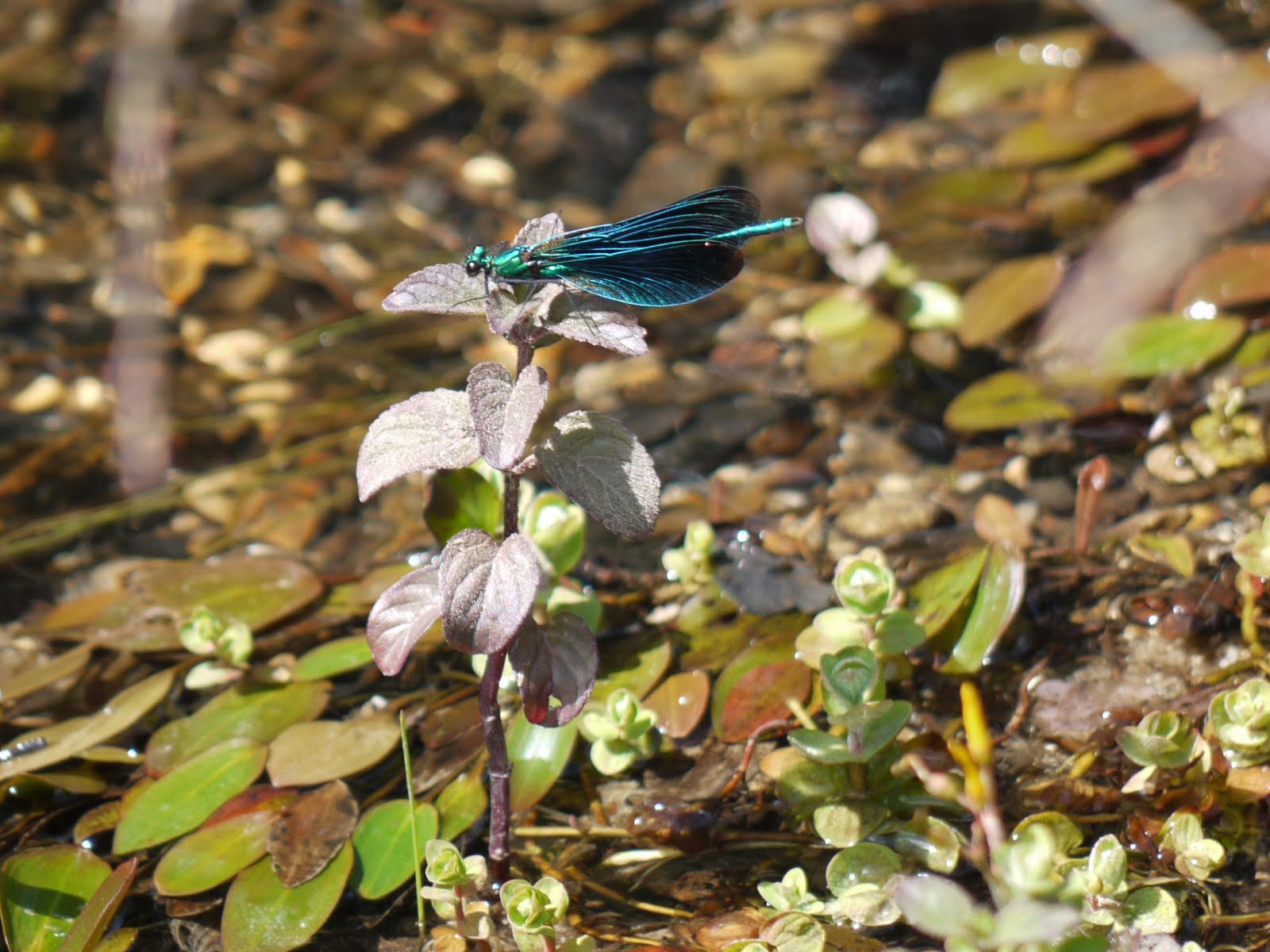
Its always a gamble with going to hunt for dragonflies as to whether the weather will be kind and favourable but we seem to have made a good decision this week with two fine and warm days - even though we booked the trip weeks ago. I was really keen to see some more species and had looked up good sites in the New Forest - and two of them did not disappoint. By a fast flowing, cool stream I found lots of these beautiful demoiselles. Their name is very apt and their flight butterfly like. The male is an incredible blue and this one was sitting enjoying the sunshine and it shone and glistened.

The female beautiful demoiselle is equally dazzling and is a metallic green with brown iridescent wings.
 They are different to the demoiselles I see locally which are also brilliant creatures but are rightly known as "banded" with their wing marking not spreading across the wings in the same was as their cousins. 

Not necessarily as stunning but equally fascinating was the next new dragon for me - the keeled skimmer. Also known as heathland skimmers this was where I found them basking low down on boggy ground wich led to very muddy and wet boots. They perch low down so the knees got wet as well! Slightly different to the black tailed skimmer and it likes the New Forest for the acidy wet heathland.
  
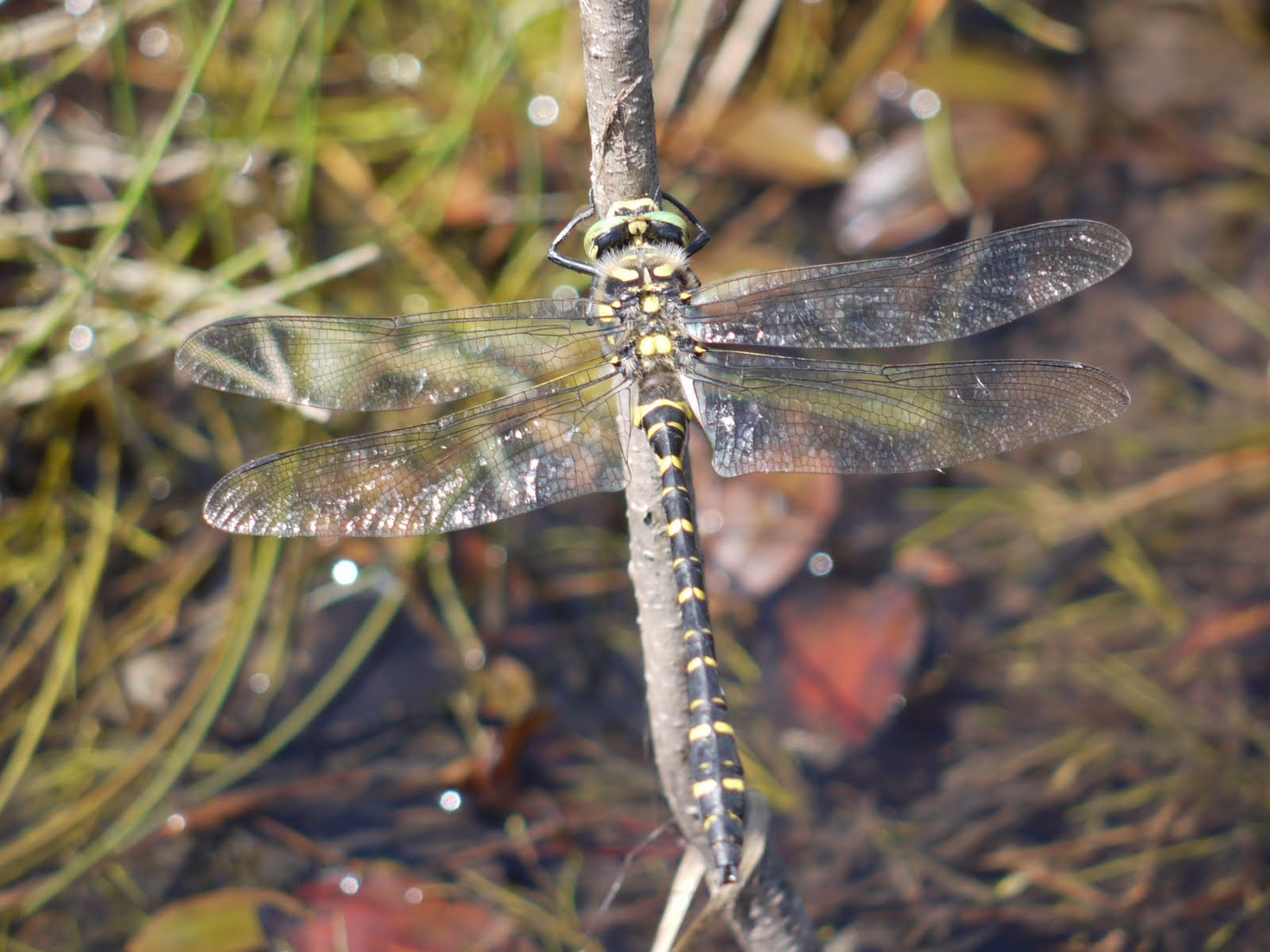
But the real high point for me was the wonderful Golden Ringed Dragonfly- a completely new family for me - the Spiketails  - Cortuleastridae.  Three Common Golden Rings were patrolling up and down the acidic stream, sometimes hawking upwards and flying off but always coming back to their territory. These are really distinctive and impressive creatures and were clearly great hunters. I was so thrilled that we went back again to ths site today and they duely buzzed and flew for me to see along teh same stretch of river. This is a very long dragonfly and its eyes are amazing and piercing. I am glad I am not on its menu. I still feel so excited seeing these as they have long been on my wish list. And the day ended with a 4th species for to add to my list- the southern damselfly or mercury bluet. Its the smallest damsel in the UK with a weak and low flight. Its flies only in sun so the sunny skies today were truely a bonus. Its called mercury because of the mark on Segment 2 - I could only see this with the bins or in my photos- but its clearly there. So a great two days- four new dragons plus large red damsels, ruddy and common darters - splendid.


Saturday, 6 August 2011

Three beauties

 This pretty moth was in my trap earlier this week but pore over it as I might, I could not decide if it was the sallw or the poplar kitten. Anyway got some expert help and it is the sallow. Why ? 
"Its mainly the shape of the band across the middle of the wing and the black lines on either edge of it. Poplar has some thickening of the black lines in certain places whereas Sallow does not. Sallow is also the commoner species in the county and is slightly smaller than Poplar on average."
It's brilliant to get help liek that - I think I would still be procrastinating otherwise!
 And this morning after a warm night the trap was full of moths for me to potter over. The most striking was this quite large moth with very clear markings. I have decided it is the swallow prominent - right time of year etc. These moths cannot feed and are from teh same family as the sallow kitten - Notodontidae. Likes poplars and willows.
Not the first time I have had this little beauty in my trap- in fact last night I had more of these than any other - but that fine by me - the Ruby Tiger -common as they say and likes herbaceious plants and shrubs which is probably why they like my garden.

Think I have got a while winters worth of moth photos to pore over and probably still need a little help!

Friday, 5 August 2011

Headlight Hawker and Poppies

 It has been a lovely sunshiney afternoon so the call to get out with the camera was too strong to resist. Headed off from home into Centennary Wood. Never been a strong favourite of mine and it disappointed again today. Despite torrential rain yesterday all the ponds were bone dry and there were just no dragons to be found. I did see two brown hawkers on the woodland rides but that was it. This is the pond where last year there were good numbers of ruddy darters but this year just lots of pretty ox eye daisies - no water , no darters.
So I walked onwards and down towards Flitton. My path took me alongside the cornfields. Every so often there were patches of vivid red poppies which stand out like little oases. They always remind me of my visit to Ephsesus which was ablaze with these bright red wildflowers. As I walked the harvest had begun in some fields, so a sign that summer is truely here and time is moving on. Why do we have harvest festival so late when the harvest is gathered home around now most years?


Onwards to Flitton Moor which was much the better part of my walk. The pond was alive with dragons today. Two emperors were going head on for their right to patrol the pond, common darters were  busy enuring the next generation and the ruddy darters glittering in the sun. There were good numbers of azure damsels, a couple of bluetails and my first for this year- the small red eyed damselfly - quite a few of these, some sunning on vegetation on the pond, others in tandem and some ovipositing. These are really delicate little damsels and they amazingly tolerate well the brackish water. I walked along the Moor and was rewarded with the Headlight Hawker- the Southern Hawker posing for me and 17 banded demoiselles dancing in the sunlight along the River Flit. On such a lovely and peaceful afternoon I walked onwards to Ruxox- where people lived over 50000 years ago and maybe watched dragons just like me - what a thought, which led to me wandering into Flitwick before heading home.

Thursday, 4 August 2011

Ubiquitous or not


 An eclectic selection of photos this evening, starting with this lovely rose. Its one from my front garden and just today the second flush of blooms looked lovely even with the rainstorms. But it made me realise how the year is marching on, a fact even more obvious when I did a little shopping and the store was full of woollens. Anyway for now the roses are looking wonderful and this one has a deep sweet scent. And then looking at the photos I had taken earlier this week of moths from the trap I realised how too these change over the weeks and just how many different moths there are.

Amongst the moths that I have not seen in my trap before was this Riband Wave. They fly mid June- mid August and like so many of the moths I see is "ubiquitous" - but its still new to me and one for me to look out for.  The distinct kink in the leading edge of the band is a feature to look out for.  I am still having to look up what leading edge or margins or outer margin et al etc mean so identification is time consuming!

 I thought this a rather ugly moth to start but having looking at it a little more it has grown on me. Its the sort of moth that would have given me the creeps in bygone years but its grown on me. It lives in the south and central part of this country and is another ubiquitous creature - the shuttle shaped dart.

Unlike the dart this one really attracted me as soon as I looked into the trap. It looks like a camouflage but it is a Broad-bordered yellow underwing. It is said to be ubiqutous as well, flies mid July- early September and has the rather catching name  Noctua janthe. 

And ending with not a moth but this rove beetle - Nicrophorus investigator - I have had a few of these in the trap this week- they live in many habitats and escape into the grass as soon as they possibly can. An interesting assortmant of creatures - lots more to peer at and see if I can work out whay they are - but never a dull moment in the moth trap world. Why doesn't everyone have one???????????????

Tuesday, 2 August 2011

Honey for the soul


I love Cambridge, and I love the Botanical Gardens there, so it wasa  real treat to spend the day in the sunshine, meet up a with a good friend, walk, talk and picnic. I have to admit there was a lot of talking but done as we ambled around the Gardens, skipped across the stepping stones on the pond, drew breathe at the colour of some of the flowers and every so often stopped for me to gaze at a dragonfly. It is difficult to pick out the best plants there were so many, but the stunning heads of the aganpanthus were amazing, and  the colours of this yellow and red plant in the hothouse (and it was hot) were striking. The scented garden was lovely until the pungent aroma of the curry plant hit us, but the soft fragrance of the lavender and the sweet scent of the old fashioned roses were lovely. It was a wonderful place to spend the day at stare at God's creation - What is the world if full of care we have not time to stand and stare - and it was like honey for the soul and cool waters on the mind and emotions. A really special day.

Monday, 1 August 2011


I am fascinated by the lifecycles and different stages of the dragonfly. So it was brilliant last week to have a go a pond dipping and this marvellous larvae was the result. It is a darter but I cannot tell if it is a ruddy or common darter. Luckily the books tell me it is almost impossible to tell the difference without a good microscope and a key. But what can I tell about this?

It is a darter of the Sympetrum family. So if it is a ruddy darter mating will have taken place on the wing with the coupled pair performing a dipping flight over the water. The female jettisons her fertilised eggs at the water surface by alternating movements of the abdomen. The male will hover nearby during this period and protect the female by driving off any approaching males.If it were a common darter the story is not so different with the eggs are not laid, but broadcast from the air: the male holds the female in tandem and swings her down and forward over water at a height of around 40cm. At the furthest point of the arc the female releases some of her eggs to fall on the water.

So thats how life started for this little creature and it will probably have overwintered as an egg and then the larvae developed very fast in spring and early summer - so its possibly a year old. But it is not ready to emerge yet. The larva are fearsome hunters. If it is a ruddy darter it will often be found alongside the emerald damselfly which is true of the site where I found it, but I know that both ruddy and common darter live there so that takes me no further.

Well in the end I probably cannot ascertain which of the two it is but that does not matter. What a fantastic lifecycle - it will eventually emerge as a truely beautiful dragonfly and then enjoy a few weeks on the wing when its objective in life will be to start the cycle all again. Lets hope that is the case and looking forward to seeing these little jewels on the wing in the sunshine for the next few weeks.

.